UFC Bet Online in the UK: The Complete 2026 Handbook
Fight-card betting without the fluff — UK-licensed, data-backed.
 Available in US
I’ve been handicapping UFC cards for ten years, and I still remember the moment I stopped treating fight betting like football. Dublin co-main event, 2019, a heavy favourite on a four-leg acca caught with a counter left hook inside ninety seconds. No build-up, no VAR to argue about — just lights out. If you want to bet UFC online in the UK and do it seriously, that’s the whole thesis: you’re not betting a ninety-minute game of small advantages stacking up. You’re betting on thin slices of violence where one read, one gassed-out fifth round, one missed weight cut changes everything.
The UK angle matters more than most overseas guides will tell you. We have one of the most regulated sports-betting markets in Europe. The UKGC licenses around 2,179 operators, and the framework keeps tightening — the statutory levy from 6 April 2025, financial vulnerability checks at £150 rolling spend, and the April 2026 duty reform that lifts Remote Gaming Duty from 21% to 40% and bolts a 25% general betting duty onto remote bets. That last one quietly rewrites the odds you’ll see on your bet slip. A UK UFC punter in 2026 is not the same punter you’d have been in 2022, and pretending otherwise is how people bleed money.
Remote betting GGY in Great Britain was £2.6 billion in 2024/25, but it fell sequentially through 2025 — £750m in October to December 2024, down to £568m by the end of September. Football owns the top of that pile, horse racing sits in second, and MMA lives in a different emotional register: shorter events, punchier variance, a prop-bet menu that keeps expanding. This handbook walks through the UKGC rules that actually matter, the markets you’ll actually use, the odds maths that earns money over time, and the responsible-gambling architecture that keeps the hobby from turning into something else.
Table of Contents
- The Short Read: UFC Betting in the UK at a Glance
- The UK UFC Betting Market in Numbers
- Is UFC Betting Legal in the UK? The UKGC Framework
- How the April 2026 Tax Reform Rewires UFC Odds
- The UFC Betting Markets You’ll Actually Use
- Reading UK Decimal Odds for MMA Fights
- Choosing a UK-Licensed UFC Sportsbook
- Where the Data Points to an Edge
- The Paramount Deal and Why It Doesn’t Change UK Viewing
- Betting Responsibly on UFC in the UK
- Your Fight-Night Checklist
- Where This Leaves the UK UFC Punter in 2026
- Frequently Asked Questions
The Short Read: UFC Betting in the UK at a Glance
- UFC betting is legal for UK residents via any of the 2,179 UKGC-licensed operators on the public register — always verify licence status before depositing.
- From 1 April 2026, Remote Gaming Duty rises to 40% and remote general betting duty hits 25%, which will tighten operator margins and show up as wider overround on UFC markets.
- Favourites win roughly 72% of UFC fights, but that doesn’t guarantee profit — closing line value, not win rate, is the true KPI.
- Missed-weight fighters won just 33% of their bouts in the 2020 dataset; short-notice fighters lost 63% — two of the strongest quantifiable signals available pre-fight.
- GamStop self-exclusion, deposit limits and the £150 vulnerability-check threshold are tools, not obstacles — use them as part of the discipline.
The UK UFC Betting Market in Numbers
A punter I coach once asked me why UFC odds in the UK feel tighter than what he’d see on American Twitter. He was benchmarking a £2.6bn remote betting market against the US habit of posting Vegas lines. Different beasts. If you want to bet UFC online in the UK effectively, the macro picture matters — it tells you where the bookmaker’s margin is being squeezed and where it isn’t.
Total gross gambling yield across the customer-facing industry in Great Britain reached £16.8 billion in the financial year April 2024 to March 2025, a 7.3% rise year-on-year. The online slice — what the regulator calls Remote Casino, Betting and Bingo — accounted for 46% of the market at £7.8bn, up 13.1% on the previous year. Inside that online chunk, remote betting pulled in £2.6bn. Football took £1.3bn of remote betting, horse racing £766.7m, and everything else — UFC included — split what was left.
£2.6bn
Remote betting GGY in Great Britain, FY 2024/25
£7.8bn
Online gambling (RCBB) GGY, up 13.1% year-on-year
£568m
Remote betting GGY by end of September 2025 — lowest point in the period
2,179
UKGC-licensed operators as of March 2025
Quarterly figures tell a story the annual headline doesn’t. Remote betting GGY peaked at £750m in the October-to-December 2024 quarter and stepped down every quarter through 2025 — £622m in April to June, and by the end of September the number had sagged to £568m. Q3 of the 2025/26 financial year showed total GGY excluding lotteries at £4.3bn, up 6.6% year-on-year, but that growth was almost entirely driven by remote casino products. Remote betting was the underperformer.

What this means for UFC punters: the bookmaker’s sportsbook division isn’t growing the way the casino division is. Overround on main events stays tighter than you’d expect for a sport with thin sample sizes, because the big UK books need MMA to hold its own against the slot machines next door in the product menu. The flip side is that prop markets — the exotic stuff where bookmakers used to be sloppy — have become much more disciplined.
The gambling industry’s total GGY excluding the National Lottery grew from £9.1bn in 2020/21 to £13.4bn in 2024/25. Almost all of that growth came from online products.
Online gambling participation sat at 39% of adults in the third wave of the 2025 Gambling Survey for Great Britain, or 16% excluding lottery-only players. Sports and racing betting specifically: around 10% of adults. MMA doesn’t move that needle on its own — the sport’s UK footprint is smaller — but it punches above its weight on individual main-event nights. UFC 300 in April 2024 generated roughly 615,000 pay-per-view buys in North America at $79.99 a pop; the UK contribution is a fraction of that, but fight nights still spike in-play volume on every major sportsbook I watch.
One structural number worth keeping: active online accounts totalled 24.4 million in FY 2024/25, but new registrations fell 4.1% to 34 million. The market isn’t expanding through new punters; it’s churning inside an existing population. Operators are fighting for a customer they already have, not chasing a fresh one — keep that in mind when we get to choosing a sportsbook.
Is UFC Betting Legal in the UK? The UKGC Framework
Short answer: yes. Longer answer: yes, inside one of the strictest operator frameworks in the world, and that’s actually a good thing for you. When Andrew Rhodes, chief executive of the UK Gambling Commission, told the Betting and Gaming Council’s AGM in February 2025 that “total gross gambling yield is at its highest ever level at £15.6 billion” and that “participation in gambling has remained stable at 48%”, he wasn’t boasting — he was describing a market held in place by the paperwork behind every licensed operator.
The UKGC is the statutory regulator for all commercial gambling in Great Britain. If you’re placing a UFC bet from a laptop in Manchester or an iPhone in Cardiff, the bookmaker on the other end must hold a remote operating licence issued by the UKGC. Holding a Malta Gaming Authority or Curaçao licence is not a substitute. The distinction matters the moment something goes wrong — disputes, payment holds, identity checks — because UKGC-licensed books must follow UK complaint procedures and route unresolved cases to approved alternative-dispute-resolution providers.
As of March 2025, the Commission regulated 2,179 operators and approximately 19,300 personal licence holders. That personal-licence number covers individuals at each company responsible for compliance, and the regulator can remove any of them, not just sanction the company. Enforcement has teeth — in the 2022/23 cycle alone, operators paid out more than £60 million across 24 cases, the largest annual total in Commission history.
UKGC — the UK Gambling Commission, the non-departmental public body that issues and enforces gambling operator licences across Great Britain under the Gambling Act 2005.
For UFC punters specifically, the practical checks a UKGC licence forces on your bookmaker are the same ones you’d want a grown-up company to have anyway. Know-your-customer checks at registration. Age verification before a first bet. Deposit limits and reality checks in the account settings. Self-exclusion that plugs into the national GamStop register. And since 28 February 2025, a light-touch financial vulnerability check at £150 net deposits over a rolling 30-day period — frictionless for most players because it only pulls data the Commission has approved for that threshold.

Licensing also fixes what markets you can access. Every UK-facing sportsbook treats UFC as a standard sports betting product — moneyline, method of victory, rounds, bet builder, futures. The markets are legally permitted; what changes between operators is depth and pricing, not legality. There’s no “grey area” around MMA betting in the UK the way there is in some US states.
One note on advertising: CAP and BCAP rules forbid gambling ads from having “strong appeal to under-18s”, and the Betting and Gaming Council’s voluntary code tightens it further. If you want to verify a bookmaker’s licence yourself, the public register on the Gambling Commission’s website lists every holder with licence numbers, addresses and status. Thirty seconds, single most useful due-diligence step you can take before depositing. Our dedicated piece on UK gambling law for UFC punters goes deeper on licence types, complaint escalation and your rights.
How the April 2026 Tax Reform Rewires UFC Odds
On the morning of 27 November 2025, I was writing up a Fight Night card when the Autumn Statement dropped and my group chat lit up. The Chancellor had just raised Remote Gaming Duty from 21% to 40% and introduced a 25% general betting duty on remote bets, both effective 1 April 2026. Every UK operator’s margin forecast became wallpaper. Every UFC bettor’s expected price on a Saturday moneyline got a little worse. Most mainstream betting guides haven’t been honest about this yet, so here it is.
The mechanics: pre-reform, remote betting was taxed at 15% on gross profits. Under the April 2026 package, remote general betting duty jumps to 25%. Remote Gaming Duty, which covers casino products, rises from 21% to 40%. Bingo duty is abolished. HM Treasury’s logic is straightforward — the gambling sector has grown substantially over the past five years, with online slot GGY alone growing 61% and representing 52.2% of the £6.9bn online gambling market before the 2025 stake limits took effect.
Every percentage point of duty that lands on a bookmaker has to go somewhere. It doesn’t come out of the shareholder dividend first. It comes out of the product.
When a sportsbook has to give up more of every pound wagered, the quickest way to recoup is to widen the overround on each market — the invisible extra percentage baked into the odds. The reason two fighters priced at exactly 2.00/2.00 represents a 100% book, but in the real world you’ll see something closer to 1.90/1.92, representing a 107% book. The difference is the house edge. If you’re wondering where the duty rise lands on your bet slip, that’s where. A shift from 103% to 106% on a UFC main event sounds trivial. Over a year of card-night betting, it compounds into thousands of pounds of worse closing line value.

Grainne Hurst, chief executive of the Betting and Gaming Council, was blunt in an August 2025 interview — a unified higher rate “would be utterly self-defeating, as it wouldn’t achieve the government’s aims of trying to raise more money”. The industry view is that if you tax operators harder, they sharpen the product less, which pushes some customers to unlicensed offshore sites. What I watch for on Saturday nights: widening overround on prop markets first, stake limits on boosted prices next, and a quieter line on welcome offers and matched free bets across the board.
Remote Gaming Duty is nearly doubling from 1 April 2026 — 21% to 40%. Remote general betting duty — which covers your UFC moneyline — goes to 25%. Bingo duty is scrapped.
What a UK UFC punter should do is simple and dull. Get better at line shopping, because the gap between the best and worst UK price on the same fight is about to become a bigger part of your bottom line. Accept that acca insurance, free-bet tokens and other promotional sweeteners will get shorter. Treat closing line value as your true performance KPI rather than short-run profit and loss. Understand that this isn’t a UK-only story for operators that serve other markets — they’ll cross-subsidise less, so the British book you use is increasingly in its own silo for margin decisions. The wider architecture of UK gambling law for UFC punters walks through the non-tax changes from 2025 too, because they all interact.
The UFC Betting Markets You’ll Actually Use
A bloke I know spent his first three cards betting only moneyline. He won some, lost some, complained that UFC betting was “boring”. Then he tried a bet builder on a featherweight barnburner, and suddenly he understood that UFC is the richest prop-bet menu in mainstream UK sport. The question isn’t “which market is best” — it’s “which market fits the read I have on this particular fight”.

Moneyline, method of victory, round betting — quick anatomy
The three core markets form a triangle. Moneyline asks who wins. Method of victory asks how they win. Round betting asks when it ends. Each step up that ladder multiplies your risk and your potential return. You don’t need to bet all three — you need to know which of the three you have the sharpest read on.
Moneyline — a straight pick on which fighter wins. In the UK this shows as a decimal price, for example 1.67 for the favourite and 2.30 for the underdog. Stake included in the return, so a £10 bet at 1.67 returns £16.70. A draw or no contest typically voids the bet.
Moneyline is the floor. Pure pick-’em, no conditions. Favourites won roughly 72% of UFC fights in 2024, which sounds like free money until you realise the implied probability at the typical favourite price already accounts for it. You can win seven out of ten moneyline bets and still go backwards. Our piece on the UFC betting strategy for UK punters lays out where the real edge lives.
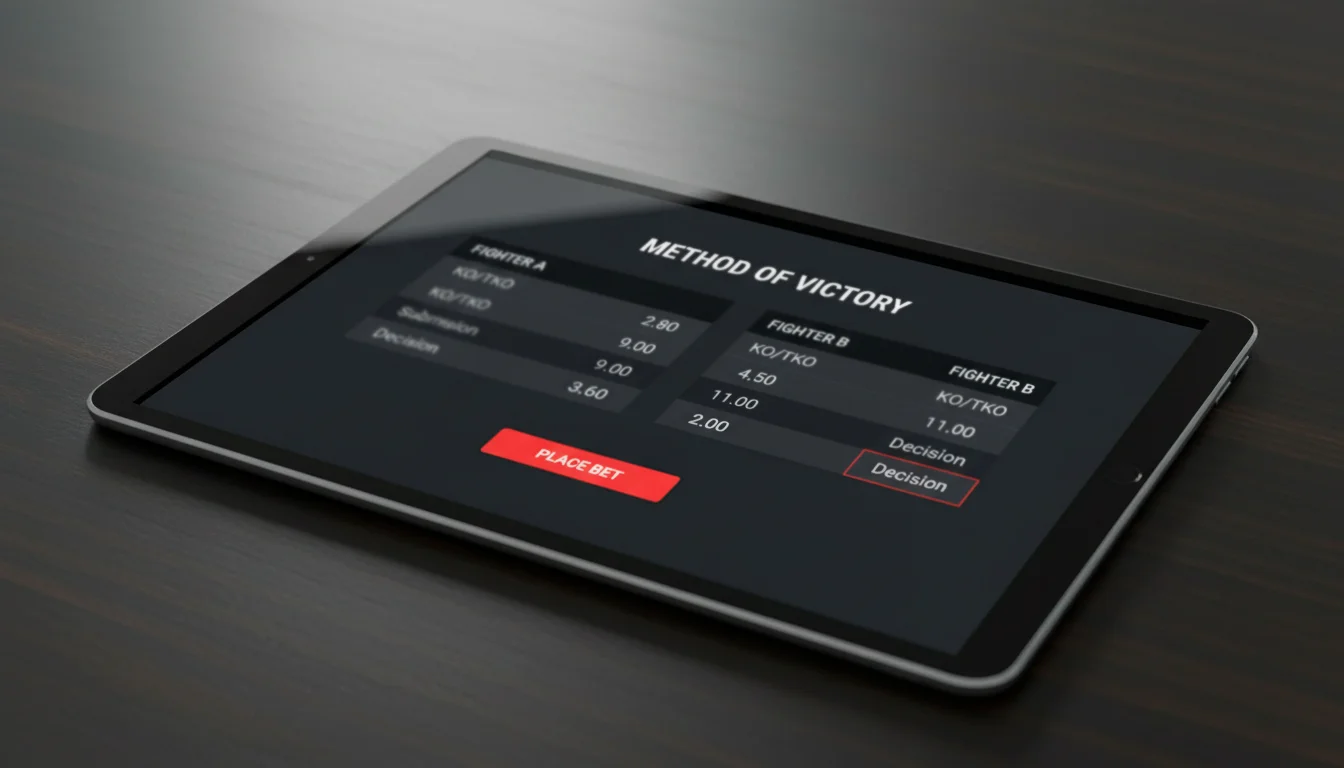
Method of victory splits the moneyline into six outcomes: Fighter A by KO/TKO, submission or decision, and the same three for Fighter B. Prices balloon because you’re combining two reads. In 2021, UFC cards hit a record 55.41% of fights ending in judges’ decisions, but the decision rate swings year-to-year. Heavyweight cards finish earlier than strawweight cards. Match the method to the division and the stylistic matchup.
Round betting comes in two flavours — exact round or group of rounds. Exact round is high-variance specialist territory. Group-of-rounds (rounds 1-2, rounds 3-4-5) is the safer shape. Either way, the settlement rules are precise: the market is on a finish occurring in that round, not on whether the fight reaches it.
Fighter A (favourite)
Moneyline 1.65 • By KO/TKO 3.40 • By submission 8.00 • By decision 3.20
vs
Fighter B (underdog)
Moneyline 2.35 • By KO/TKO 5.50 • By submission 12.00 • By decision 4.80
Illustrative example. The six method prices must exceed 1.00 in implied probability — the excess is the overround the book takes.
Totals (over/under rounds) is a separate market. The book sets a line — usually 1.5, 2.5, 3.5 or 4.5 rounds — and you bet whether the fight goes over or under. Settlement hinges on “halfway through the round” rules: typically, going past the 2:30 mark counts as the full round. Five-round main events bend the totals differently to three-rounders.
Bet builders combine markets inside a single fight, priced by the operator’s internal model. The pricing engine accounts for correlation, which is why 1.65 x 3.40 x 2.50 doesn’t come out at 14.03 — if Fighter A wins by KO/TKO inside the distance, that’s three correlated outcomes. Operators have their own algorithms, which is why the same four-leg builder is priced materially differently across UK books. The dedicated breakdown of UFC betting markets shows where correlation creates pricing gaps.
Props and card-level markets finish the picture. Fight of the Night, Performance of the Night, fastest finish, total KOs. Dana White announces Performance bonuses publicly, and UK books price the FOTN market through fight-night. At a 2024 contender-series press scrum, White openly talked about bonuses going up — “just the number that the bonuses bring to a fighter is millions of dollars” — and books price accordingly. Lower-stake markets with firmer caps, but they reward deep card knowledge.
Reading UK Decimal Odds for MMA Fights
The single biggest edge-in-waiting for most UK punters isn’t fight knowledge. It’s that they look at a price of 1.90 and process it as “almost even money, seems fine” without doing the quick maths that tells them whether it is, in fact, fine. Decimal odds are friendlier than the American plus/minus system, but friendly isn’t the same as transparent. Here’s how I read a UFC price in five seconds.
Implied probability — the probability of an outcome as priced by the market. For decimal odds, it’s 1 divided by the price. A 1.67 quote implies 59.9% probability; a 2.50 quote implies 40%.
Take any decimal price and divide 1 by it. 1.50 means 66.7%. 2.00 means 50%. 4.00 means 25%. Now add the implied probabilities of both sides of the moneyline together — 1/1.67 + 1/2.30 = 0.599 + 0.435 = 1.034, or 103.4%. Anything above 100% is the bookmaker’s overround. Real UK sportsbooks run between about 103% and 108% on UFC main events, with prop markets running higher. Underdogs win approximately 35% of UFC fights historically; favourites about 65% in the broader historical sample.
Once you understand overround, two habits become automatic. The first is line shopping. The same fight will be priced differently across UK books — not hugely, but enough to matter. If Fighter A is 1.67 at one operator and 1.75 at another, you’re giving up real money by not checking. Over the course of a year, those small gaps are the difference between beating the market and donating to it.
The second habit is converting American quotes. A negative American number (-150) means 100/(150+100)+1 = 1.67 decimal. A positive American number (+150) means 150/100+1 = 2.50 decimal. You’ll see American quotes constantly in MMA content, so internalise the two formulas.
Worked example: UFC main-event moneyline
Fighter A at 1.55, Fighter B at 2.55.
Step 1: Implied probabilities. 1/1.55 = 64.5%. 1/2.55 = 39.2%.
Step 2: Overround. 64.5% + 39.2% = 103.7%. House edge = 3.7%.
Step 3: “Fair” probability (remove the vig). 64.5 / 103.7 = 62.2%. 39.2 / 103.7 = 37.8%.
Reading: the market makes Fighter A a 62% real favourite. If your own read makes them a 70% favourite, you may have positive expected value. If your read makes them a 60% favourite, you’re betting against the closing line.
Expected value is (your probability × decimal price) – 1. If that number is positive, the bet is theoretically profitable over the long run. If it’s negative, it isn’t. You will never know your “true” probability with the precision you’d like, but you can train yourself to reject obvious minus-EV bets. The favourite at 1.20 with your read at 75%? That’s 1.20 x 0.75 – 1 = -0.10, a 10% negative EV. Don’t take it. Over enough fights, the maths doesn’t care about a single result.
Choosing a UK-Licensed UFC Sportsbook
Here’s the uncomfortable truth nobody writing “top 10 UFC sportsbooks” listicles will tell you: the answer to “which UK bookmaker is best for UFC” depends entirely on you — your stake size, your market preferences, your withdrawal patience. What I can give you is a framework. Three criteria out of the seven I work with actually separate a competent UK UFC sportsbook from a bad one.
This section covers the top three. For the full seven-criteria scoring framework, our dedicated piece on UFC betting sites in the UK goes into the weighting and the audit process I actually use.
BEFORE YOU DEPOSIT
- Verify the operator holds an active UKGC remote betting licence on the public register
- Cross-check the company name on the register against the one on the bookmaker’s footer
- Scan the deposit-methods page for credit-card offerings (banned since 2020 — a red flag if present)
- Find responsible-gambling tools in the account menu within two clicks
- Note the published withdrawal timing bands for your chosen payment method
UKGC licence is non-negotiable. The regulator’s public register lists every licensed operator with a licence number, trading names, date of issue and current status. Some sites present themselves as “UK-friendly” while only holding a Malta Gaming Authority or Curaçao licence — those are not acceptable for UK-resident punters. You lose the UKGC’s dispute resolution, the affordability-check framework, and you may be breaching the operator’s own terms of service by claiming UK residency.

Market depth on UFC is the second filter. The bar is simple: moneyline, method of victory, round betting (exact and group), over/under totals, bet builder, and a FOTN prop. If a book offers only moneyline and over/unders on UFC, it’s treating the sport as a sideline and you’ll see it in the pricing. The deepest UK books offer 20 or more props on a numbered main event — fight ends in round X, takedown props, knockdowns, decision-type splits.
Withdrawal speed and banking friction matter more than the welcome offer. UK operators cannot accept credit cards since April 2020. Standard options are Visa debit, Mastercard debit, PayPal, Skrill, Neteller, Apple Pay, and open-banking methods like Trustly and Pay by Bank. Withdrawal timing varies enormously — a debit card withdrawal might be instant on one book and 3-to-5 working days on another. What you want before depositing is a published timing band, not a vague “same day for VIP”.
A quick comparison by characteristic — not by brand, because the point isn’t rankings:
| Criterion | What strong looks like | What weak looks like |
|---|---|---|
| UKGC licence | Active remote betting licence, name matches footer, clear licence number | MGA-only, Curaçao, licence number absent or for a different entity |
| UFC market depth | 20+ props on numbered main events, bet builder covers all core markets, live in-play round-by-round | Moneyline and totals only, no bet builder, no round betting |
| Withdrawal speed | Published timing bands per method, e-wallet same-day, debit card <72 hours | Vague timing promises, manual review bottlenecks, weekend delays unpublished |
One number to anchor your thinking: 74% of UK in-play wagers are placed on phones or tablets, which means mobile UX is no longer a bonus — it’s the primary product. A bookmaker whose bet-slip loads slowly on a flaky pub Wi-Fi is not going to keep your business through a year of fight cards.
Where the Data Points to an Edge
Four numbers changed how I bet UFC. I want to show them as a single block, because the trap in edge-data is to take one number and run with it. Favourites winning 72% of 2024 UFC fights doesn’t mean bet every favourite. Reigning champions retaining titles 63% of the time as underdogs doesn’t mean bet every title-defending champion at a plus price. Each number is a conditional signal that has to be combined with context.
72%
UFC favourites won 72% of fights in 2024. Broader historical data puts favourites at ~65% and underdogs at ~35%
63%
Of 19 instances where reigning champions defended belts as underdogs, they retained titles 12 times
33%
Fighters who missed weight at weigh-in won only 33% of their bouts in a 2020 dataset of 323 fights
37%
Fighters taking bouts on less than one month’s notice won only 37% of the time (i.e. lost 63%)
Weight misses and short-notice replacements are the two biggest “hidden” signals I’ve seen pay out over a decade. They’re hidden because the UK media coverage of a UFC card is thin, and the line often doesn’t move enough on Friday afternoon to reflect what’s happened on the scale. If Fighter A missed weight by three pounds and the line is still +120 on Fighter B, the market is giving you an opportunity that won’t exist at close. The question isn’t just “is the signal real” but “how much do I risk”.
For the champion-underdog pattern specifically, the same guide has the detailed breakdown of all 19 historical cases. The short version: experience in championship rounds, the ability to make small adjustments between rounds and the psychological clutch of being in front of a title-defence crowd seem to give reigning champions a small but persistent edge. Don’t bet every champion-as-dog blindly. Do pay attention when the market makes a long-reigning champion a +140 or +180 dog in a title defence.
A caution on the 72% favourite figure. Fighting sports are particularly brutal for “bet chalk forever” strategies, because the implied probability on a -200 favourite (1.50 decimal) is already 66.7%, and you pay the overround on top. You can win 72% of your bets and lose money if the prices you take imply higher probabilities than that. This is why closing line value matters more than short-term profit and loss as a feedback signal.
Striking-stats superiority is another signal in the same range. Fighters with superior career striking statistics won a reported 72% of their fights in a 2020 dataset of 323 bouts — a different 72% from the favourite win rate, but similarly slippery. “Superior” needs careful definition: total strikes landed isn’t the same as significant strikes per minute, which isn’t the same as strikes absorbed. Before you build a model, pick one metric and stick with it.
Two markets-adjacent numbers to close. The weight-miss signal is strongest when it’s a weight-class regular who has made the cut five times before and suddenly doesn’t. A debut fighter missing weight tells you less — they’re still learning the cut. The short-notice penalty of 63% losses is strongest when the short-notice fighter is stepping up in weight class. Moving from welterweight to light-heavyweight on three days’ notice is a different proposition from a featherweight taking a bantamweight fight. For the definitive piece on the favourite hit rate, weight-miss trading and champion-as-underdog spots, our UFC betting strategy for UK punters covers the sizing and the trading windows.
The Paramount Deal and Why It Doesn’t Change UK Viewing
I got about twenty messages on 11 August 2025 asking if I was “worried” about the Paramount deal. Short version: no, and neither should you be, because the United Kingdom is not in the Paramount+ territory list. The seven-year, $7.7bn deal between UFC and Paramount covers the United States, Latin America, and Australia from 2026 — the UK is not included. In practice, UK fans will continue watching UFC through UFC Fight Pass and TNT Sports, with numbered pay-per-view events still sold through those channels.
What actually changes for UK punters
Nothing about where you place the bet. UKGC-licensed bookmakers don’t depend on US broadcast rights. What might shift is the UK fan’s psychological relationship with the sport — in the US, the PPV model is ending and every numbered event moves onto a subscription. In the UK, numbered events remain PPV, and the Paramount shift surfaces as a news story rather than a viewing change.
Dana White framed the announcement in typical Dana White terms: “This historic deal with Paramount and CBS is incredible for UFC fans and our athletes. For the first time ever, fans in the US will have access to all UFC content without a Pay-Per-View model, making it more affordable and accessible.” That’s the US narrative. The UK narrative is quieter because UK viewers were already mostly getting UFC through subscriptions — UFC Fight Pass for the Fight Nights, TNT Sports for marquee numbered events, supplementary PPV purchases on top. The business mechanics on our side are unchanged.
There is a second-order story worth flagging. The Paramount deal got signed because PPV buys had been softening. UFC 312 in February 2025 (Du Plessis vs Strickland 2) drew only 176,000 PPV buys — a stark contrast to UFC 300 in April 2024, which hit approximately 615,000 PPV buys at $79.99 in North America. UFC 311 in January 2025 generated 240,000 buys after Arman Tsarukyan’s last-minute pull-out forced Renato Moicano into the main event. Star-power volatility and PPV attrition were the backdrop to the Paramount decision, and the new deal translates to roughly $1.1 billion per year over seven years, up from around $500 million annually under the ESPN arrangement.
Why does this matter for a UK punter? Card strength drives betting liquidity even on your UK sportsbook. A card with a big-name main event has deeper prop markets, tighter lines and more cash-out flexibility than a card with two relatively anonymous contenders. UK fans will keep paying to see UFC, just through different channels than American fans.
Betting Responsibly on UFC in the UK
There’s a version of this section in most betting guides that reads like a regulatory footer. I’d rather treat responsible gambling as part of the strategy, because the punters who get hurt aren’t betting recreationally — they’ve lost bankroll discipline and can’t step away. Baroness Fiona Twycross, UK Minister for Gambling, put it cleanly in the November 2024 announcement of the statutory levy: “Gambling harm can ruin people’s finances, relationships and ultimately lives. We are absolutely committed to implementing strengthened measures for those at risk.”
The UK numbers are worth knowing. Approximately 0.5% of UK adults meet clinical criteria for problem gambling under PGSI prevalence data — roughly 340,000 adults. Another 1.8 million are classified as “at risk”. The GamCare National Gambling Helpline takes over 55,000 calls per year. A GambleAware survey of 18,000 adults found that 5.3 million people in Great Britain want to reduce or quit gambling, and 43.7% of them are aged 18-to-34.
UK responsible-gambling architecture at a glance
Every UKGC-licensed sportsbook must offer deposit limits, loss limits, session reminders and a self-exclusion option that plugs into the national GamStop register. Financial vulnerability checks trigger at £150 rolling net deposits since 28 February 2025. The statutory levy, effective 6 April 2025, funds research, prevention and treatment at 0.1-to-1.1% of operator GGY. NHS gambling clinics, GamCare helpline, and GambleAware treatment signposting are free at point of use.
UFC betting carries a specific risk profile. Short events — three or five rounds — make wager-reset-wager patterns common on fight night. Live markets update quickly, which can make chasing losses feel justified as “in-play reading”. KO moments create dopamine spikes. None of this makes UFC betting dangerous. It makes structure important. I keep a pre-card ceiling on total stake (typically 2% of my bankroll across a numbered card) and I don’t chase after a prelim goes against me.
The young-person data from November 2025 matters too. The Ipsos and UKGC “Young People and Gambling 2025” study found that 8% of under-18s had gambled online in the past twelve months, including 3% who’d placed a bet via a betting website or app. If you have a teenager in your household, account and payment-card security on your own betting account is part of your responsibility as the adult using it.
Practical tools, in order of friction. Reality check pop-ups — set one for every 30 or 60 minutes of session time. Deposit limits — the single most useful tool, set below your walk-away threshold. Loss limits — secondary. Time-out — 24 hours to six weeks, reversible. Self-exclusion via GamStop — covers every UKGC-licensed site for 6 months, 1 year or 5 years, and cannot be undone within the term.
If you or someone you know needs help, GamCare is the first call — 0808 8020 133, 24/7, free and confidential. NHS gambling clinics operate across Great Britain with free CBT-based treatment. Our dedicated piece on responsible UFC betting in the UK covers the tools and the signposting in detail. Professor Henrietta Bowden-Jones, National Clinical Advisor on Gambling Harms for NHS England, welcomed the levy by noting it provides “an independent evidence-based strategy at last”.
Your Fight-Night Checklist
Every UFC card I bet on gets the same audit before I put money down. Not because I’m meticulous — because forgetting one item has cost me money often enough that the ritual saves me from myself. Here’s the checklist I work through, starting about 48 hours before the card.
BEFORE YOU WAGER
- Check the Friday weigh-ins for any missed weight. A fighter missing weight by more than one pound is a different bet than the one you researched on Wednesday. The 33% win-rate signal for missed-weight fighters is too strong to ignore.
- Scan for short-notice replacements. If a fighter is in on less than four weeks’ notice, apply the short-notice heuristic — 37% win rate in the historical dataset — and expect the market to have priced it incorrectly in the first 24 hours.
- Read line movement across at least two UK books between the opening line and 24 hours pre-fight. A steady drift towards one fighter is more informative than a single snapshot price.
- Audit your own read. Write down the method, round and winner you’d bet if all were the same price. Then look at the prices. This stops you from being pulled into a bet by the number rather than the read.
- Confirm your bankroll cap for the card. My rule is 2% of bankroll across all bets on a single numbered event, 1% on a Fight Night. It has to be a number you set in writing before the broadcast starts.
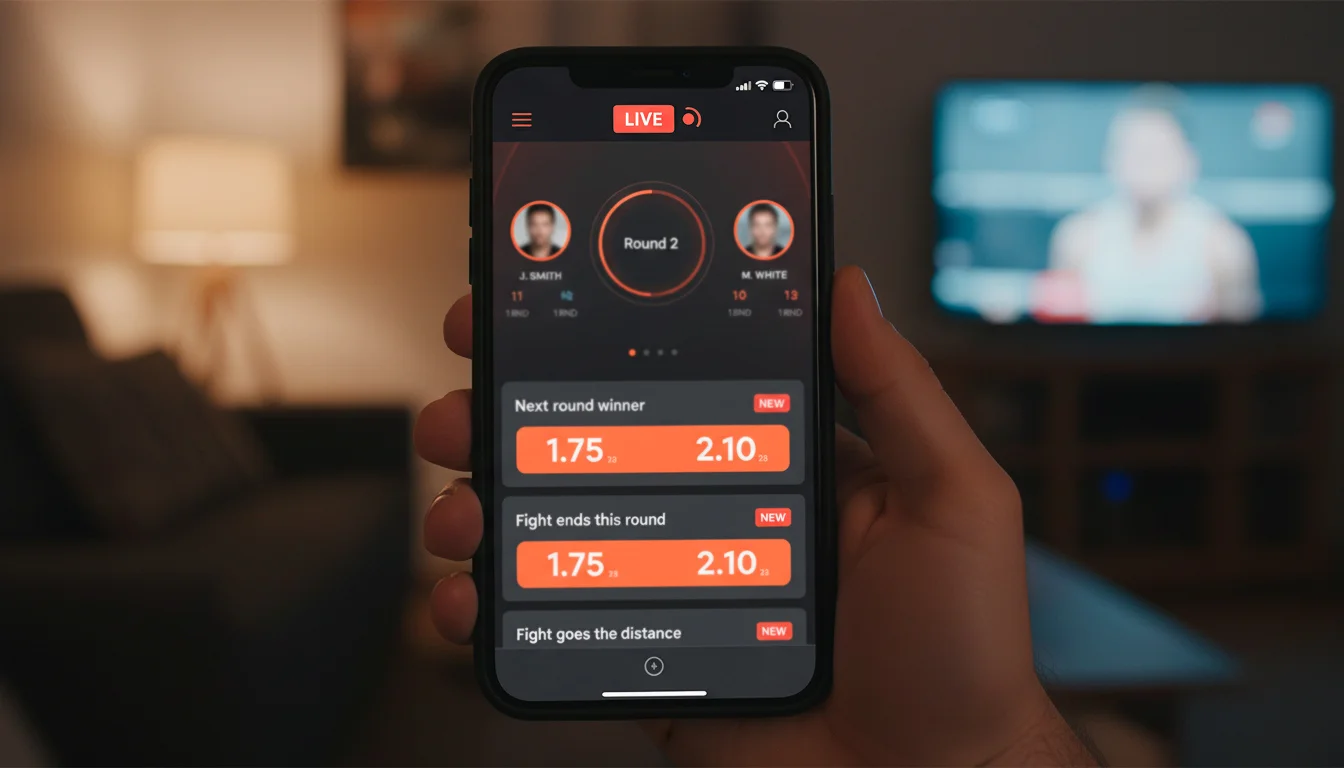
- Check in-play availability. Not every UK book offers round-by-round live markets, and if in-play is your plan, confirm cash-out mechanics beforehand, not during a takedown sequence.
- Set your reality check. Six hours of live UFC viewing is a lot of exposure. A 60-minute reality check pop-up gives you a natural pause point.
- Verify the fight order and estimated times. PPV scheduling slips, prelims run long, and a rushed bet on the wrong fight is a quick way to start a losing card.
The last item deserves a sentence of its own. I’ve watched experienced UK punters confuse the main card and prelim opening lines because they were toggling between Fight Pass and their bookmaker’s app and the fight names blurred. If you’re betting a bet builder or a prop market, double-check the fighter names on the slip before you submit. It’s boring and basic, and it saves the one or two wager-typos a year that happen to all of us.
Where This Leaves the UK UFC Punter in 2026
If you’ve read this far, you already know more about the mechanics of betting UFC online in the UK than 90% of the people reading “top bookmaker” listicles. The tax reform, the UKGC framework, the data signals around weight misses and short-notice fights, the way overround compounds quietly through a year of wagers — none of that is secret, but it’s rarely pulled together in one place with UK realities at the centre.
What I’d leave you with is a mindset, not a system. Treat every bet as an expected-value question. Shop the line across at least two books. Log your closing line value and trust it more than your short-run profit and loss. Use the UKGC’s tools as part of the strategy, not separate from it. Then read the next tier of detail for the markets you actually use, because that’s where the handbook stops and the real learning starts.
UFC betting in the UK in 2026 is a regulated, data-rich, maths-driven hobby — not a vibe-based entertainment product. The bookmakers who stay sharp will keep overround tight on core markets; the punters who stay sharp will line-shop, size discipline, and use the responsible-gambling architecture as a feature. The edge is real, small and slow.
Frequently Asked Questions
Is UFC betting legal in the UK?
Yes. UFC betting is legal for anyone aged 18 or over in Great Britain, provided you bet with an operator that holds an active UK Gambling Commission remote betting licence. The UKGC regulated approximately 2,179 operators as of March 2025. Operators licensed only in jurisdictions like Malta or Curaçao are not authorised to accept UK-resident customers. The public licence register lets you verify any operator in under a minute before depositing.
Which UK bookmakers hold UKGC licences for UFC markets?
Most of the major UK sportsbooks you’ve heard of hold active UKGC remote betting licences and list UFC as a standard sports product — moneyline, method of victory, round betting, totals, bet builder and card-level props are widely available. Rather than recommend any single operator here, I’d point you to the UKGC’s public register to verify licence status yourself, and to our framework piece on UFC betting sites in the UK. Brand-name doesn’t equal quality — market depth, in-play mechanics and withdrawal speed vary enormously.
How will the April 2026 tax reform affect UFC odds for UK punters?
From 1 April 2026, Remote Gaming Duty rose from 21% to 40% and a higher-rate general betting duty of 25% applies to remote bets. The practical effect on UFC odds is indirect but real — operators typically recover additional tax cost by widening overround on each market. A UFC main event at 103% overround might drift to 105-to-106%, which over a year compounds into materially worse closing line value. Free-bet offers, acca insurance and welcome bonuses are likely to shrink. Line shopping becomes more valuable, not less.
What types of UFC bets are available on UK sportsbooks?
The core menu covers moneyline (straight winner), method of victory (KO/TKO, submission or decision for each fighter), round betting (exact round or group), totals (over/under a set round line), bet builder (combined markets within one fight) and props (Fight of the Night, Performance of the Night, card-level markets like total KOs or fastest finish). Deeper books add specialty markets — scorecard exact lines, distance props, futures on division champions and year-end awards.
How do I read decimal odds for a UFC fight?
UK decimal odds show your total return per £1 staked. A 1.67 price means a £10 stake returns £16.70 if the bet wins. To convert to implied probability, divide 1 by the price: 1/1.67 = 59.9%. Add the implied probabilities of both sides of a moneyline together to see the book’s overround — 1.67 on Fighter A plus 2.30 on Fighter B gives 59.9% + 43.5% = 103.4%, meaning a 3.4% house edge. The lower the overround, the better the price you’re getting.
Can I live-stream UFC fights through a UK betting app?
Generally no. UK betting operators do not hold UFC streaming rights — those sit with UFC Fight Pass (subscription) and TNT Sports, with numbered events typically also available as pay-per-view through those channels. You’ll place bets on a UKGC-licensed app while watching through Fight Pass or TNT Sports separately. The Paramount+ deal announced in August 2025 covers the US, Latin America and Australia from 2026 but does not extend to the UK.
Where can I get help if UFC betting stops being fun?
GamCare runs the National Gambling Helpline on 0808 8020 133, free and confidential, open 24/7. NHS gambling clinics operate across Great Britain with free treatment, including cognitive behavioural therapy. GamStop is the national self-exclusion register — one registration blocks every UKGC-licensed operator for 6 months, 1 year or 5 years. Every UK-licensed operator offers deposit limits, loss limits, time-outs and reality checks inside the account settings. Tim Miller, the Commission’s executive director of research and policy, has emphasised that the UKGC’s job includes “looking at what the potential path forward would be” to keep consumer protection moving with industry change.
Created by the ”ufc bet Online” editorial team.